Transactions Between the Partner & Partnership: An Overview
Section 707 of the Internal Revenue Code deals with the treatment of transactions between a partner and a partnership, and in particular, those circumstances where a partner is not acting in his or her official capacity as a partner. Say, for instance, we have a partnership that is in the business of travel planning. Suppose its 50% partner, Matthew, who is also the lead booking agent, decides he does not want to pay the local handyman to fix a plumbing issue in the partnership’s bathroom and would rather do it himself. Matthew certainly could, however, the road would get murky if Matthew were to charge the partnership for his plumbing services. How is Matthew treated in such a case? And, what about the partnership? We will peruse IRC § 707(a)-(c) to answer these questions and consider the overarching question: what does it truly mean to act within one’s capacity as a partner?
Payments to a Partner
There is no hard and fast rule under the Code that defines what it means to act within one’s capacity as a partner in a partnership. However, Treas. Reg. § 1.707-1(a) provides “[a] partner who engages in a transaction with a partnership other than in his capacity as a partner shall be treated as if he were not a member of the partnership with respect to such transaction” (emphasis added). This language indicates there is a tangible difference we can see: if a partner is not acting in his capacity as a partner, he is acting independently (as if he were a third party). The point is reinforced with several examples including loan transactions, the rendering of services, and the sale of property between the partner and the partnership. Therefore, in determining whether a partner is acting in his capacity as a partner, we need to look to the facts and circumstances to determine whether the partner engages in a core function of the partnership or is acting independently.
a. Partner Acting in Capacity as a Partner
Ordinarily, a partner who receives cash or property from a partnership (i.e., a current distribution), the distribution will reduce the partner’s outside basis and potentially result in gain to the extent the distribution exceeds the partner’s basis. See IRC § 731.
b. Partner Acting as a Third Party
Without this, a partner can render services and abuse the entity.
Guaranteed Payments 707(c)
Publications
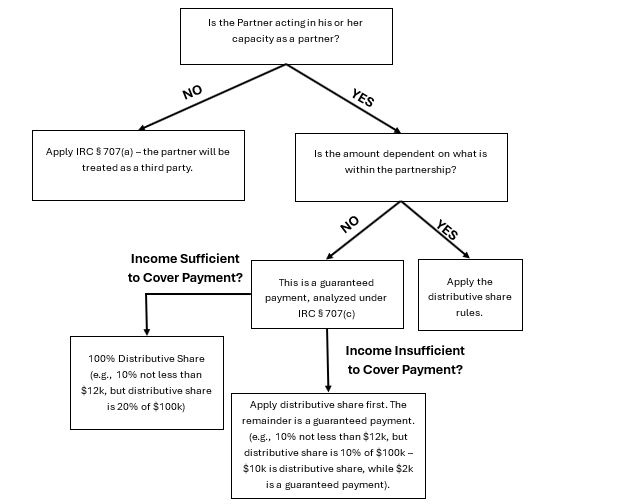
Analytical Framework for Analyzing IRC § 707 Issues
Disclaimer: this article and the analysis and educational materials on this site are not intended to be construed as tax or legal advice. No author of the materials published on this site is engaged in rendering legal or other professional advice and these publications are therefore not intended to be an alternative for seeking the advice of an attorney, CPA, or other professional advisor. If you are seeking legal, tax, or other professional advice, you should seek the services of a competent attorney or other professional.